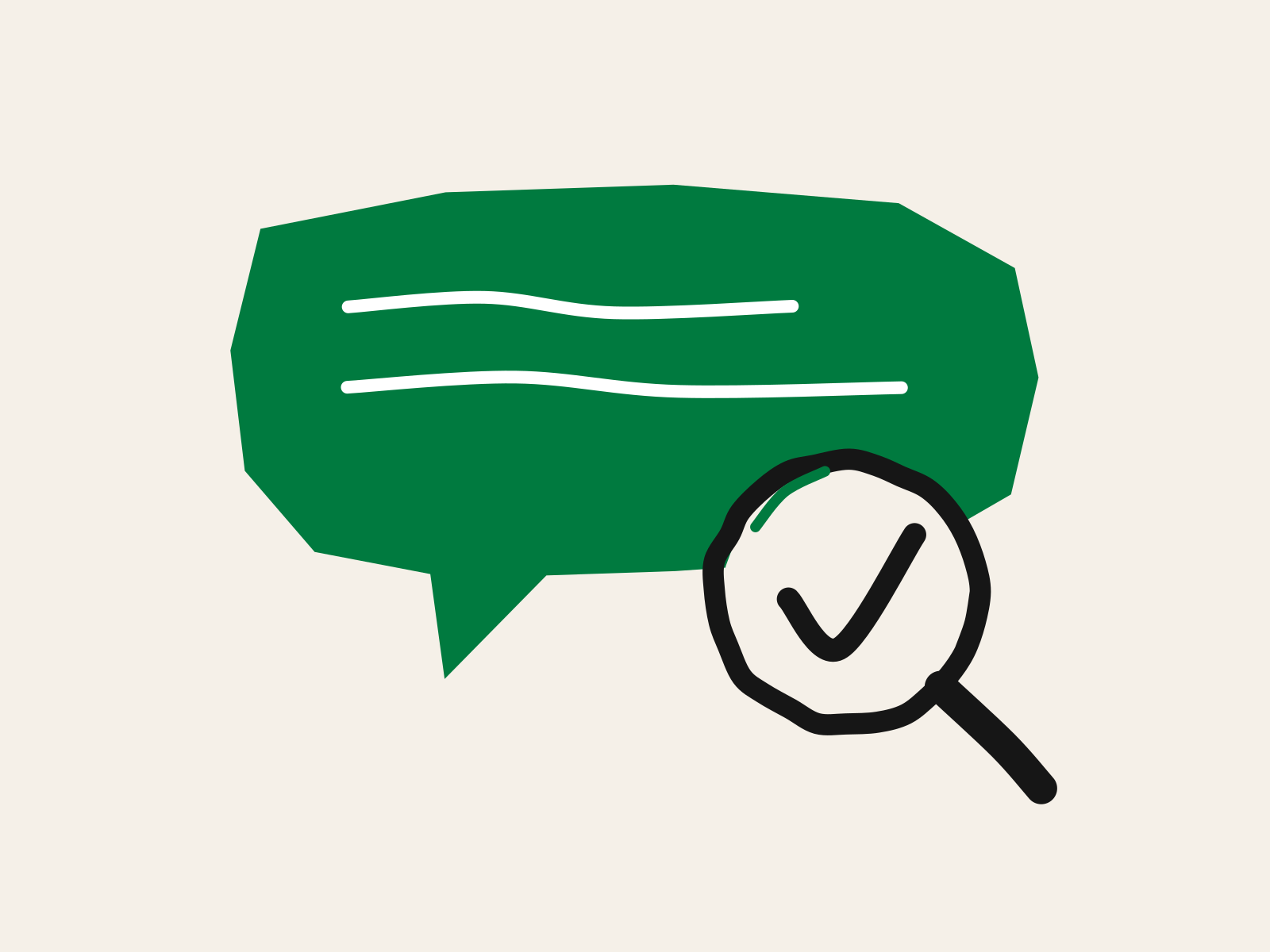
Teach one habit: a fact does not count until it has left the chat. Your child finds the same claim somewhere a named person or organization stands behind it, such as a textbook, an encyclopedia or a government site. Chatbots sound sure even when they are wrong, so the checking has to happen outside the chatbot. For health or safety questions, ask a professional first.
Why does a chatbot get things wrong while sounding so sure?
Because it is built to produce plausible text, and plausible is not the same as true. OpenAI's own researchers describe hallucinations as "plausible but false statements generated by language models," and in a September 5, 2025 paper they explain one cause: the tests used to train and rank these systems reward a confident guess over an honest "I don't know." Facts that are rare and arbitrary, such as an obscure date or name, cannot be worked out from patterns, so that is where guesses turn into errors. OpenAI says accuracy will never reach 100 percent, because some questions have no answer to find.
OpenAI's help center says the same thing in parent language. ChatGPT can sound convincing while giving incorrect or misleading information, it can make up quotes and citations, and it should not be anyone's only source for research.
That is the evidence. Here is my reading of it: children trust fluency. When a person talks that smoothly about a subject, they usually know it. A chatbot breaks that rule, and nobody has told most children.
Do children really need to be taught this?
Many are already relying on chatbots to find things out. In a Pew Research Center survey of 1,458 US teens aged 13 to 17 (fielded September 25 to October 9, 2025, published February 24, 2026), 57 percent had used a chatbot to search for information and 54 percent to get help with schoolwork. The survey counts teens who live with a parent.
A second signal comes from England. Computing reported on September 24, 2026 on a Public First survey of nearly 4,000 people aged 11 to 24, run for a report by Anthony Seldon and Tim Bunting. Of those surveyed, 47 percent said they would trust AI to check whether a fact is accurate, against 21 percent who said they would trust a person. Computing does not give the base for each figure, so read the numbers as a signal, not a measurement. They describe what young people say they would do, not what happens to their grades or what is true.
The good news is that checking can be taught. A Stanford study, published in April 2022, of about 500 high school students in one Midwestern school district gave half of them six 50-minute lessons on what fact-checkers do. Fact-checkers read "laterally": they leave the page they are judging and open new tabs to see who is behind it and what others say. After the lessons, students were about twice as likely to spot questionable websites. They still earned only half the possible points, and the study was about websites, not chatbots, so it shows the skill can be learned rather than that it solves AI answers. It also says something I would not skip: children did not pick this up on their own just because they grew up with screens.
What is the one habit to teach?
I call it the Leave the Chat check. Before an AI answer counts, your child takes the claim out of the chat and finds it in a place where a named person or organization stands behind it.
It has four moves, and a ten-year-old can learn all four:
- Pick the claim that matters. Not the whole answer. The date, number, name or quote that the homework, the essay or the decision will rest on.
- Search for the claim, not for the chatbot's wording. A new browser tab, not a new message to the same chatbot.
- Ask who is behind what you find. A school, a museum, a government agency, a publisher, a named expert. This is the Stanford "leave the page" move in kid form.
- Find it in more than one place, and write down where. Brookings, in a tip sheet for parents on its site, suggests checking at least three other reliable sources, and offers two questions for children to ask: how do you know, and where did that come from? My suggestion: start with two sources for a child of 8 to 10, and move to three for the claim that matters most.
A word on asking a second chatbot. Brookings suggests asking a child what they would do if two chatbots gave different answers, and I like that as a conversation starter. My own view is that a second chatbot is a second opinion from the same kind of machine, not a second source. It can raise a flag. It cannot close the question.
What can we try tonight?
Play Catch the Bot. It takes ten minutes and it is a suggestion of mine, not a tested program.
Pick a topic your child knows better than you do: their favorite game, a football club, a breed of dog, a book series. Sit beside them and ask a chatbot three specific questions whose answers can be checked, such as a date, a name and a number. Your child marks each answer right, wrong or not sure, using what they know and one reliable source.
I would use a niche topic because, on OpenAI's own account, rare facts are where models guess. That is not a promise that any answer will be wrong. If the chatbot gets all three right, that is a result worth talking about too. Then ask it for its sources and check that each one exists, since fake citations are a documented problem.
You could say: "Let's see if it knows your game as well as you do. You be the judge."
Keep real names, your school, your address and photos out of the questions. Use a tool your child is old enough for under that tool's own rules (the post on what age kids can use AI covers the age limits), and follow your school's rules on AI first.
What do I say, by age?
Under 8. Children this young should not use a chatbot alone. If they meet an AI answer, the habit is a question: "Who told us that?" Look it up together in a book or a trusted site. You could say: "A computer said it. Let's ask the book if the book agrees."
8 to 12 (elementary into middle school; Years 4 to 8 in England). Catch the Bot is made for this age. Teach the two-source rule and the two questions, "How do you know?" and "Where did that come from?" You could say: "Before it goes in your homework, show me where else it says that."
13 to 15. Add the lateral move: leave the page, see who is behind the source. Talk about what a chatbot cannot do, which is know that its answer is wrong. You could say: "What would change your mind about this answer, and where would you look?" My earlier post on talking to your teen about AI and homework has more of the conversation.
16 to 18. Raise the standard: check the numbers, open every citation, and learn that a source named by a chatbot may not exist. Remind them that their school or exam board decides what disclosure of AI use is required, and that rule beats any habit of mine.
What I See in Schools
The pattern I see most often is a student who can tell you which chatbot they used and cannot tell you where a fact came from. The assignment rarely asks for the second answer, so nobody supplies it. The practice I would look for in a school is simple: students show how they checked, not only what they found, with a short list of sources or a line saying what was verified and where. That one change turns checking from an extra into part of the work.
What should I ask my child's school?
Three questions work at a parents' evening. Do you teach students how to check an AI answer, and at what age? Do students have to show their sources and how they checked them? Who decides when AI use has to be disclosed? If your child's school has not yet spoken to parents about AI, this is the work I do with schools: AI training for schools. It is worth sending them this page.
When does someone else's rule come first?
Your school's AI rules come first on any schoolwork. A tool's own age limit comes first on whether your child should use it. For anything about health, a body, safety or a feeling that worries you, a pediatrician, a teacher or another trusted adult comes before any checking routine, and a chatbot does not stand in for any of them. No habit makes an AI answer safe to act on for those questions.
A chatbot's answer is where the checking starts, not where it ends.
If you want the related picture, start with what AI is, in plain English, and the post on how to explain AI to a child. I also write a Sunday newsletter that keeps teachers and parents up to date without the panic, and parents are very welcome: join here.
Dan Fitzpatrick is the founder of The AI Educator, a Forbes contributor and a former secondary teacher and assistant headteacher. More about Dan.